
Ibrahim Rashid
Resistance to Erasure
November 15, 2025 – February 2, 2026
Community Gallery – Lounge
Resisting Erasure explores the intersections of power, identity, and memory within systems of political control and biopower. Rooted in Rashid’s experiences in Iraq under a totalitarian regime. Through large-scale mixed media techniques, he examines how authority shapes the body and nature, silences narratives, and seeks to erase cultural memory.
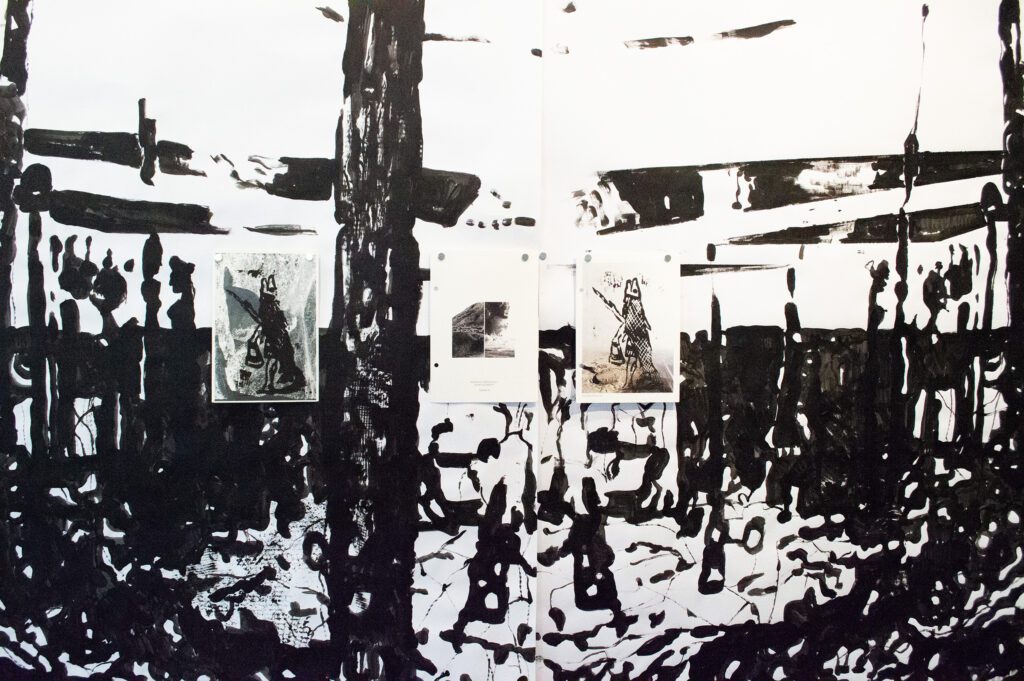
Image Credits: Ibrahim Rashid, Resistance is Erasure, Art Gallery of Burlington, 2025. Mixed media, ink, acrylic, woodcut printmaking, photo, and digital print on paper. Photo Credits: Ema Walters


What does “resisting erasure” mean to you, and why share these stories here at the AGB exhibition?
Resisting erasure is refusing the loss, distortion, and marginalization of collective and personal history. I work with fragments—pulling the past into the present. After leaving Baghdad in 1991, I began painting in Sweden, but acrylic’s stillness couldn’t hold the distance between the worlds many of us live in: past/present, reality/imagination, East/West. That pushed me toward mediums like video, where sound and movement let memory shift in time and scale.
In this body of work, landscape and figure collapse into each other—house, water, birds, trees, fish, people—until inner/outer and real/mythic blur. Because this project is archival in approach, I returned to wood engraving: carving is excavation; each incision is a record, revealed in ink like an X-ray.
I’m also guided by Ibn Rushd’s insistence that thought can’t be suppressed—“ideas have wings.” In that sense, my practice is resistance as both protest and repair. Showing these stories at the Art Gallery of Burlington matters because it puts them into a shared civic space—where they can be met, questioned, and carried forward. And because I work daily in my studio in Burlington, the exhibition connects the place where the work is made with the place where it’s received, keeping these histories present rather than distant.

"In a culture that speeds up forgetting, remembering is resistance."
– Ibrahim Rashid
What do you hope visitors take away from experiencing this exhibition in the Community Gallery Lounge?
I want visitors to sit with fragments—memory, loss, survival—without being given a complete narrative. I use the wound as a form: not decoration, not spectacle, but a fissure where what’s buried becomes visible. As people carve marks into tree roots, I carve into printing wood.
For me, “resisting erasure” is an archive of the individual and the community. To reopen it is to face what’s been pushed toward oblivion. The work isn’t an invitation to suffering—it’s a route toward transformation, where pain can move toward healing.
How did your early work as a newspaper and magazine illustrator shape how you think about art and drawing today?
Working in the press taught me that drawing is a responsibility. Under censorship, images had to speak fast—often indirectly. That trained me to treat drawing as a language: compressed, symbolic, precise. It still shapes my work, even as it has become slower, more layered, and more experimental.

How do you use your art as protest and as personal and collective healing?
I turn lived realities—exile, war, censorship, erased identity—into forms that refuse silence. The process itself heals: repetition, reconstruction, restoring materials, returning to what was damaged.
I think of my grandmother knitting while telling stories from One Thousand and One Nights—memory and imagination braided into unexpected patterns. My work follows that logic: inherited symbols, nature, emotion—reassembled into images that can hold both protest and repair. The works become shared witness: they carry grief and also insist on continuity.

How does resistance appear to you today compared to earlier in your career?
Earlier, resistance meant speaking through metaphor and coded images—ways to survive repression.
Now it’s slower. In a culture that speeds up forgetting, remembering is resistance. Returning to informal, original stories—like those carried through the making of old carpets—is a direct refusal of erasure. Personal and collective memory remain the core of my work, because they confront deliberate oblivion every day.
Meet Ibrahim Rashid
Ibrahim is a multidisciplinary artist whose practice engages sociopolitical themes, focusing on the land and human beings both as political bodies through radical and mythological imagery. He works across painting, drawing, printmaking, video, and writing.
In the 1980s, Ibrahim worked in Baghdad as an illustrator for national magazines and newspapers, publishing art articles that critiqued cognitive violence and the sociopolitical realities under the ruling regime during the Gulf War. His artwork and writing reflected the collective experience of political instability and its effects on the human body and land during wartime. After graduating from the Academy of Fine Arts, Baghdad (1982), his early practice was profoundly shaped by his experience serving on the warfront. After immigrating to Sweden in 1991, Ibrahim expanded his practice through studies in screen printing and digital art, exploring identity and landscape in trans-migratory contexts. In 2009, he pursued a professional year toward an MFA at the University of Waterloo, Canada.
Ibrahim’s works have been widely exhibited across Scandinavia, Europe, North America, the South West Asian and Northern Africa, including the Mori Contemporary Art Museum (Tokyo), MAI (Montréal), the Sharjah Biennial (UAE), KWAG 5th Biennial (Canada), Malmö Art Museum (Sweden), YYZ Artists’ Outlet (Toronto), and Darat al Funun (Jordan). His awards include grants from the Canada Council for the Arts, Ontario Arts Council, Toronto Arts Council, Swedish Arts Grants Committee, and Swedish National Council for Culture.
Resistance to Erasure was completed with support from Toronto Arts Council.

AGB’s Community Generator is a series of community-arts projects and activations geared to serve more artists and audiences. The programs are dedicated to creating equitable and open processes for artists and community organizations across the Burlington, Hamilton, and Halton Region to apply for free access to exhibition spaces, arts education, and studios.
The 2026/27 application will be available online May 2026.