

We Dig Learning
2026 School and Group Programs – FALL
The Art Gallery of Burlington offers engaging, inquiry-based field trip experiences for learners of all ages. Through guided gallery tours and hands-on studio activities, students connect directly to our current exhibitions through close looking, conversation, and hands-on making.
A visit to the AGB includes a 30-minute guided gallery tour of the exhibitions on view, followed by a 90-minute studio workshop led by professional artist educators. Programs are designed to explore how contemporary art connects to lived experience, making meaningful connections between curriculum, materials, and the world at large. Our Learning team is dedicated to supporting all learners in developing critical thinking, visual literacy, and creative confidence.
- We offer the following 90-minute studio programs:
- Clay – hand building (all ages)
- Clay – wheel throwing (Grade 9 +, maximum of 12 students)
- Printmaking (all ages)
- Watercolour (Kindergarten – Grade 6)
- Intermediate Painting (Grade 7+)
- Wire Sculpture (Grade 7+)
Programs are offered for a range of ages and learning levels. Please let us know if there are learning experiences that can be tailored to meet the specific needs of your group, including curriculum links, accessibility considerations, or multi-visit formats that allow for deeper engagement with studio projects and exhibitions.

Kindergarten
Seeing, Feeling, Making
Young learners explore contemporary art through the senses. Students practice close looking, movement, and storytelling to connect artworks to their own experiences. Studio activities focus on play, discovery, and learning art vocabulary through doing.
Curriculum Focus: Exploration, oral language, visual literacy, creative expression
Exhibition-Based Inquiry Question: How can shapes, colours, or patterns help tell a story?

Primary (Grades 1–3)
Stories, Materials, and Imagination
Students begin to explore how artists use materials, colours, and shapes to tell stories. Through guided conversation and hands-on making, learners build art vocabulary while connecting personal experiences to artworks on view.
Curriculum Emphasis: Communication, materials exploration, storytelling, foundational design concepts
Exhibition-Based Inquiry Question: How do artists use materials to share memories or ideas? What happens when an artist changes or reshapes a familiar pattern?
Junior (Grades 4–6)
Ideas, Materials, and Meaning
Students investigate how artists make choices to communicate ideas. Exhibition tours emphasize interpretation, pattern, and material experimentation, while studio projects encourage problem-solving, reflection, and purposeful making.
Curriculum Emphasis: Elements of design, critical thinking, cultural context, creative process
Exhibition-Based Inquiry Question: How do materials carry meaning? Why might an artist choose certain patterns or images to tell a story?

Intermediate (Grades 7–8)
Perspective, Process, Visual Language
Students deepen their understanding of contemporary art by examining how artists use materials, processes, and visual strategies to explore identity, memory, and culture. Studio work supports experimentation, conceptual development, and reflection.
Curriculum Emphasis: Conceptual thinking, process documentation, visual analysis, social context
Exhibition-Based Inquiry Questions: How can art reflect personal, cultural, or historical perspectives? How does meaning change in transforming materials or images?

Secondary & SHSM (Grades 9–12)
Contemporary Practice and Critical Inquiry
Designed for high school learners, this program focuses on critical discussion, conceptual frameworks, and material investigation. Students analyze artistic intent, ethical considerations, and cultural narratives while developing independent studio approaches aligned with secondary learning goals.
Curriculum Emphasis: Critical analysis, material research, artistic intent, career pathways in the arts
Exhibition-Based Inquiry Questions: How do contemporary artists use material and imagery to question history or identity? What responsibilities do artists have when working with cultural or archival references?
Specialist High Skills Major (SHSM) and Postsecondary
Collection/Connection
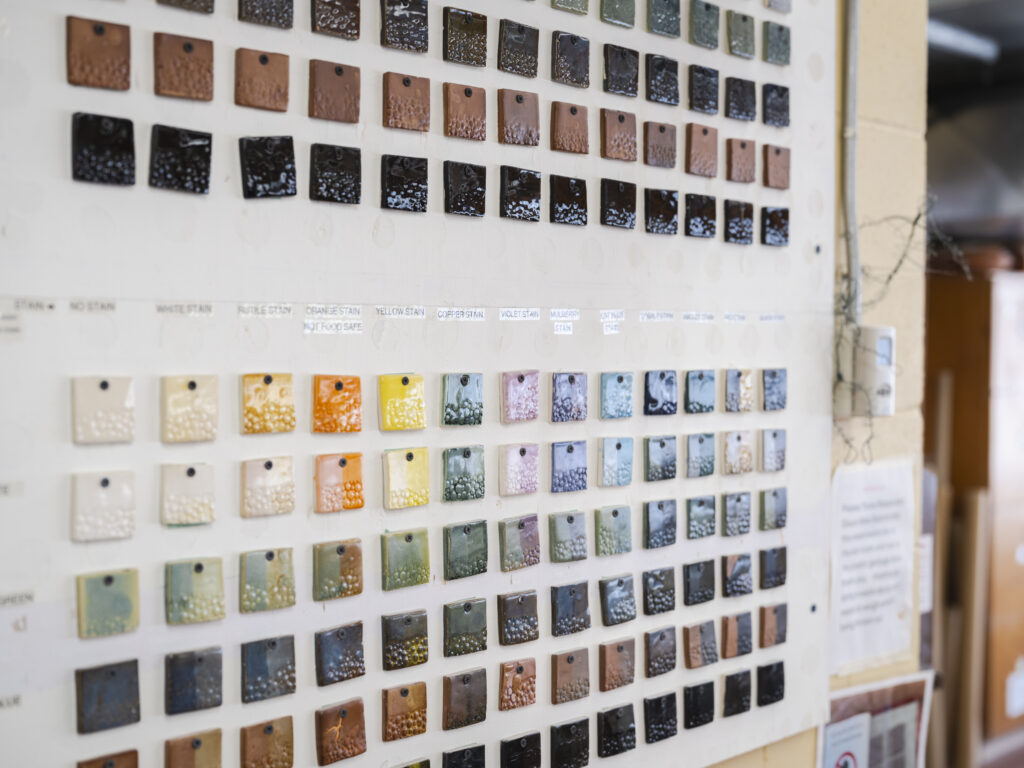
This behind-the-scenes experience is designed to support SHSM Arts & Culture sector competencies by introducing students to professional practices within galleries and museums. Students explore how cultural institutions collect, care for, interpret, and present artworks, with a focus on contemporary ceramic practices.
Led by the AGB’s Collections team, students gain in-depth insight into the roles, workflows, and decision-making processes involved in collections management, exhibition preparation, and material care. With access to one of the largest collections of contemporary Canadian ceramics, students examine how material choices influence conservation, display, and public interpretation.
Following the tour, students participate in a hands-on ceramics workshop in the AGB’s pottery studio, connecting technical skill development with professional standards and workplace expectations in arts and cultural sector.
Please note: Wheel-throwing capacity is limited to 12 students per session. Food-safe glazes are available for an additional fee of $12 per student.
Inspired School Visits
A visit to the AGB includes a 30-minute guided tour of our current exhibitions, followed by 90 minutes of hands-on artmaking in our studios. Led by our skilled gallery guides and artist educators, students build confidence in their creative and critical thinking skills, using art to connect curriculum learning with real-life experiences.
Wiigwasitig / Waskway / Honouring the Birch Tree includes the works of five First Nations artists focusing on Wiigwas (birch bark) to reflect themes of intergenerational knowledge and healing. Coming from Anishinaabe and nêhiyawak communities over several generations, the exhibition features wearable art, birch bark biting, film, and photography through an intersection of traditional and contemporary forms. The works of Pat Bruderer (Halfmoon Woman), Helen Pelletier, Amber Sandy, Seth Arcand and the late Angelique Merasty are curated by Albany Sutherland, opening conversations on the significance of knowledge systems in sustaining relationships with the Land and kin.
Paper Pals Collective’s Paper Bound explores a deep connection to the living world through printmaking, paper arts, and mixed media. From relief prints of swimming sea turtles to Suminagashi paper marbling, eco-printing, and woven paper works, each piece reflects the patterns, rhythms, and textures found in nature. Working with Japanese and Western papers, recycled materials, thread, and natural dyes, the artists embrace layered processes that celebrate the forms and interconnectedness of plants, waterways, landscapes, and living systems. Together, the exhibition reveals the beauty of the natural world while inviting viewers to consider their own relationship to the environments that sustain them.
For nearly a century, the paintings of Abdur Rahman Chughtai have shaped the visual language of modern South Asian art through delicate figures, lyrical compositions, and dreamlike atmospheres that occupy an enduring place within Pakistan’s artistic imagination. In Chughtai Moving Portraits, Los Angeles-based artist and producer Mahnoor Euceph reactivates this legacy through moving image. Rather than treating Chughtai’s paintings as untouchable historical artifacts, Euceph approaches them as living works capable of generating new meanings. Through moving image, she extends their visual language into the present, revealing that artistic inheritance is not fixed but continually shaped through reinterpretation. Here, movement is not simply an aesthetic device; it becomes a curatorial and artistic method for thinking with history rather than around it.
School and group visits can be scheduled during the following times:
- Wednesdays: 9:30–11:30 am or 12:30–2:30 pm
- Thursdays & Fridays: 9:30–11:30 am
- Evenings (Tues–Fri): 6:00–8:00 pm
Program fee: $18 per person (minimum 15 participants)
Smaller groups may book for a flat rate of $270.
Please note that the AGB does not have a cafeteria or other dedicated space for eating lunches or snacks before or after a scheduled school visit. Any required lunch rooms or break spaces must be booked in advance with the Learning Coordinator and will incur an additional charge for your visit to reserve the space for your group and cover the costs of set-up and cleaning.
Please contact our Learning Coordinator, Moyu Chen, at moyu@agb.life if you require a lunch room for your visit.
Thanks to the generous support of the Joyce Family Foundation, the AGB offers subsidies to schools needing financial assistance for field trips. Fifteen subsidies are available each year to help offset the cost of in-gallery educational experiences.
The subsidy application opens each September for the upcoming school year.
Our 2025–26 bursaries have been fully awarded. Please check back next September.
For details, contact our Educational Team.