
Phuong Nguyen
“she died a death by a thousand cuts”
“Chinoiserie is both a style and an ideology. It is at once the stuff of enchantment, unfurling a seemingly endless range of luxuries wrapped in layers of ornamentation, and at the same time a system of entrapment that holds you captive to a process of objectification.” [1]
In her exhibition “she died a death by a thousand cuts,” Toronto-based artist Phuong Nguyen constructs a haunting meditation on colonialism, cultural appropriation, and the spectral life of objects. Through painting, weaving, wood carving, and ceramics, Nguyen excavates pictorial renderings of women inscribed on Chinoiserie, as well as the troubled archive of L’Art à Hué (1919), a French colonial-era publication that documented the arts and culture scene of the Vietnamese former imperial capital, Hue.
L’Art à Hué and similar publications of the time functioned as products of ongoing Western colonialism in several ways. Documenting local art and architecture through an explicit European lens, Vietnamese aestheticism was exoticized for French audiences while simultaneously serving to justify colonial presence by presenting Westerners as preservers and appreciators of the local culture. These publications effectively controlled and fetishized the narrative around the artistic heritage of Vietnam, typically employing orientalist frameworks that portrayed the country as in need of European interpretation, reinforcing colonial hierarchies and a supposed Western cultural superiority.
In her studio, Nguyen’s photocopied version of L’Art à Hué sits on her worktable bound in a thick, plastic binder. Heavily flagged with post-it notes and English translations handwritten in the margins, highlighted and dog-eared pages note architectural designs as fodder for creating her frames and incised ceramic tiles. Named after the image plates in the book (Planche CXCV, Planche XCIV, and so on), Nguyen’s drawings and carvings reimagine and reclaim the patterns found in these pages.
Nguyen’s unexpected encounter with Chinoiserie happened in the “Chinese Room” at Casa Loma, where she restored antique furniture and paintings. There, her fascination with the intricate blue and white paintings of women, florals, and dragons circling the vessels was accompanied with learning about the fraught histories of misrepresentation and appropriation the style has become infamous for.
She began using these ceramics as models for new paintings, growing her own collection from garage sales, the Hudson Bay closing sale (where they once served as display props), or gifted by friends. In her collection, broken pieces sit alongside intact ones, some laced with ribbons and twine while others are stacked in tall, delicate towers. Nguyen’s studio is also filled with thrifted fabrics, stretching across frames or draped loosely over crates. These materials function equally as props and building elements, embodying a mix of treasure and trash that resists any hierarchy between the precious and the disposable.
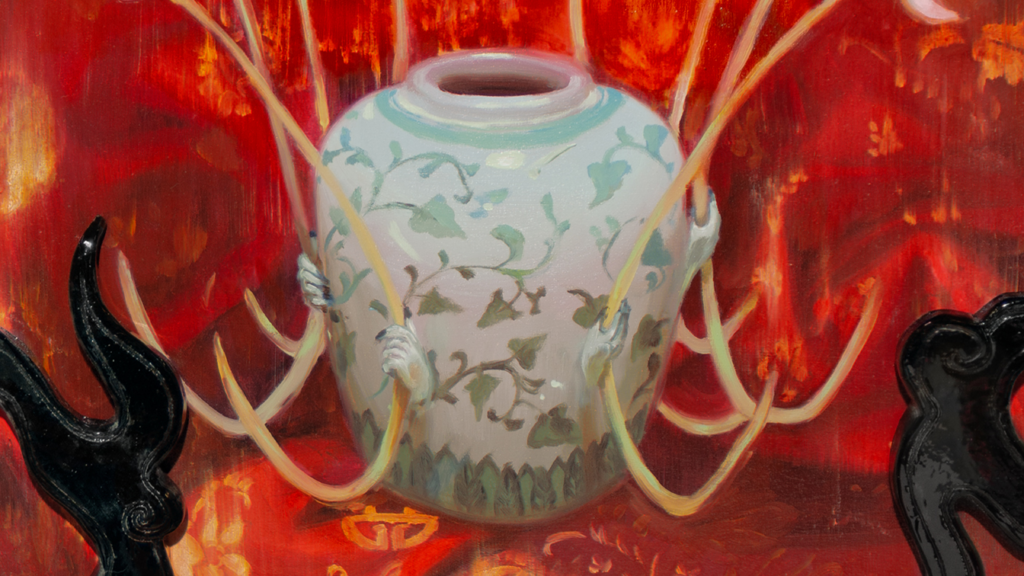
These renderings don’t become inanimate still lifes. Instead, active hands breach the skins of vessels like anthropomorphic forms sprouting like flowers from the bellies of vases, while braided hair spills out from lids, and waves of incense surround containers. Nguyen’s pieces become increasingly dark and peri-human (not quite human, not quite object), existing in an in between state of living and dead, still and moving.
Built from an expanding vocabulary of materials, Nguyen’s paintings take on a sculptural form that extends far beyond the canvas surface. Each work is suspended within elaborate frames made of carved wood, rattan weaving, and cascading lengths of glass beads, pearls and velvet ribbons.
The addition of clay in Nguyen’s practice emerged during her exploratory residency in the AGB’s pottery studios (2025), where she began creating ceramic components designed to decorate and hold her paintings. Some of these ceramic frames were constructed from overlapping and folding slabs over one another, their surfaces draped with chains or glazed so that drips appear frozen in motion. Some echo the look of black lacquered wood curling around the corners of traditional painted frames, blending ceramic experimentation with historic reference.
Some of the images held within those frames show delicate hands holding smoldering incense sticks, harking to the Vietnamese tradition where incense serves as a medium of communication with the spiritual realm. The smoke acts as a shifting scrim whose translucency gently veils the scene. Multiple figures converge, abstracted within their compositions as the incense simultaneously flattens perspective and settles palpably on the canvas surface, muting what lies beneath. Thin wisps of grey curl around vessels, casting them in a ghostly shadow suspended between corporeal and spirit.
This haunting quality resonates with the themes explored in the Metropolitan Museum of Art’s recent exhibition Monstrous Beauty, curated by Dr. Iris Moon, which unravels the disturbing history of Chinoiserie through a feminist lens. The exhibition’s title, “she died a death by a thousand cuts,” draws directly from Moon’s catalogue essay, which examines the cumulative harm produced by fetishization, particularly through the persistent archetype of the Asian femme fatale. [2] Like Moon’s curatorial intervention, Nguyen’s work refuses to let colonial violence remain decorative. The beauty of Chinoiserie and the aesthetics of Southeast Asian femininity cannot be separated from the one thousand cuts of exoticization, objectification, and erasure that bind them.
Acting as another form of specter, she died a death by a thousand cuts includes chinoiserie from the Gardiner Museum’s permanent collection. These historic pieces carry their own displaced meanings, forgotten labour, and fractured cultural narratives. The physical attendance of the ceramics supports critical interpretation by allowing visitors to view archival objects directly referenced and reanimated by Nguyen.
Despite the heaviness of Nguyen’s subject matter, her work remains tender. Delicate weaving, care of objects, and handwritten translations acting as methods of retrieval and repair. If ornamentalism and orientalism are forms of violence, they are also sites where resistance can be carved into being, one cut at a time.
[1] Dr. Iris Moon. Monstrous Beauty. (Metropolitan Museum of Art, 2025), pg. 16
Meet the
artist
Phuong Nguyen
Born and raised in Tkaronto (Toronto), Phuong Nguyen is a visual artist working in representational oil painting and experimental weaving. Nguyen uses these mediums to explore themes of Ornamentalism and the relationship between exoticism and violence by referencing the aesthetics and the history of Chinoiserie and South East Asian/Vietnamese femininity.
Nguyen’s work was recently recognized by the CIBC C2 Art Program 2024 (as a finalist), and by the Canada Council for the Arts (2025) where she won both the Travel, and the Visual Artist Creation Grant. Nguyen was featured in the solo exhibition She is An Object of Beauty (Atlanta, USA, 2025), and in The Wind Return To The Soil (Montreal, Canada, 2023). In 2025, Nguyen was selected for the following Canadian group exhibitions: Interwoven Identities (at the Asian Arts and Cultural Trust), A Familiar Distance (at Tian Contemporain), and Pattern and Motif (at Design TO Festival @ Gladstone Hotel). Nguyen also contributed to art fairs in group shows such as Murmurs: A Gathering of Modern and Contemporary Arts from Vietnam (Shanghai, China, 2025), and for both Tian Contemporain and SSEW Projects at Art Toronto (Toronto, Canada, 2025). Nguyen holds a BFA from OCAD University (2014).
Gallery

Image Credit: Phuong Nguyen, "she died a death by a thousand cuts," Art Gallery of Burlington. 2026. Photo Credit: Darren Rigo

Image Credit: Phuong Nguyen, "she died a death by a thousand cuts," Art Gallery of Burlington. 2026. Photo Credit: Darren Rigo

Image Credit: Phuong Nguyen: "she died a death by a thousand cuts," Art Gallery of Burlington. 2026. Photo Credit: Darren Rigo
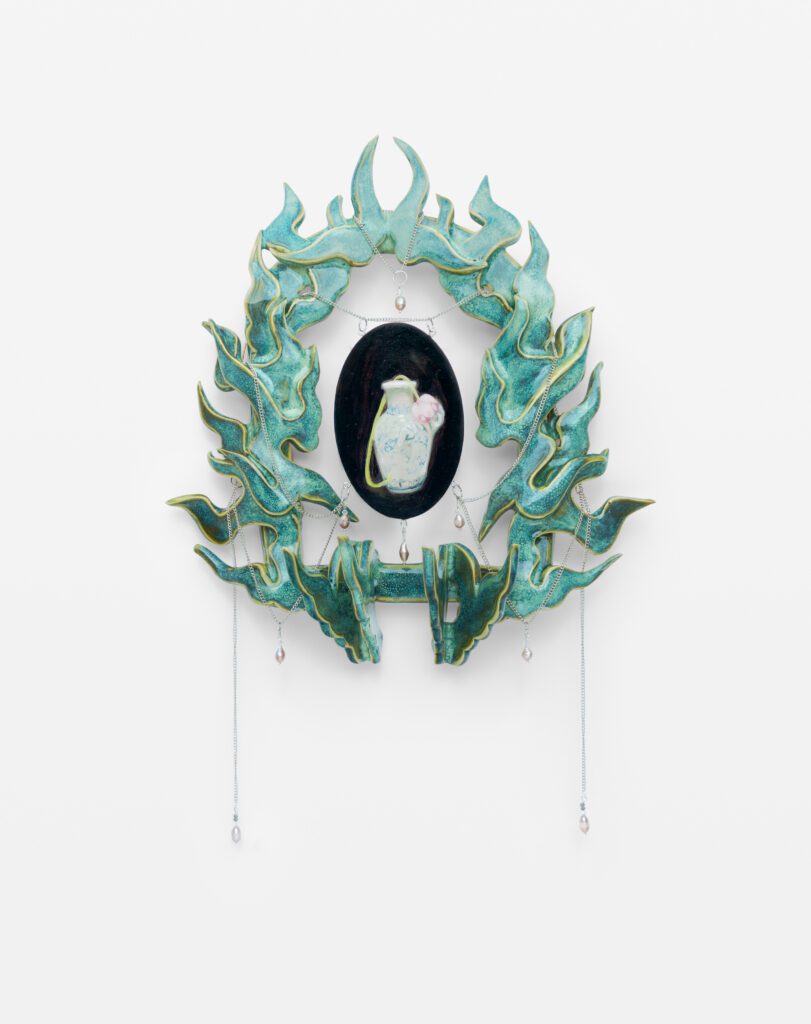
Image Credit: Phuong Nguyen, Planche CXCV, Mixed Media (Oil on panel, ceramic sculpture, jump rings, chain, glass beads freshwater pearl), 20"x14"x5", 2025. Photo Credit: Greg McCarthy

Image Credit: Phuong Nguyen: "she died a death by a thousand cuts," Art Gallery of Burlington. 2026. Photo Credit: Darren Rigo

Image Credit: Phuong Nguyen: "she died a death by a thousand cuts," Art Gallery of Burlington. 2026. Photo Credit: Darren Rigo

Image Credit: Phuong Nguyen: "she died a death by a thousand cuts," Art Gallery of Burlington. 2026. Photo Credit: Darren Rigo
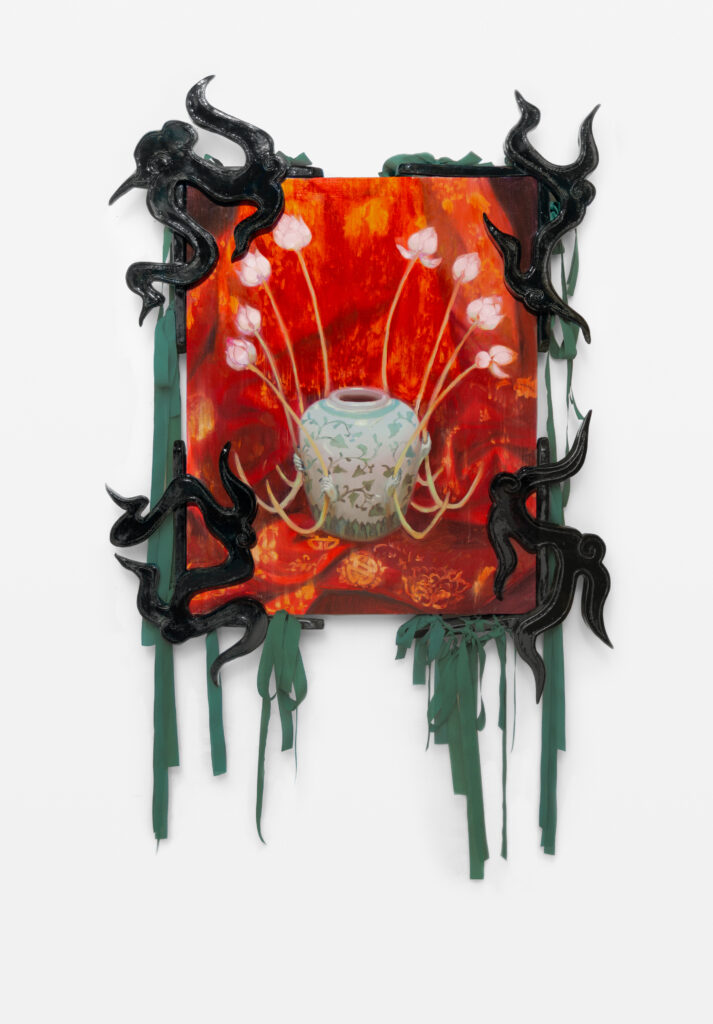
Image Credit: Phuong Nguyen, Planche LXX, Mixed Media (Oil on panel, ceramic sculpture, crepe ribbon), 36 X 24 X 5", 2025. Photo Credit: Greg McCarthy

Image Credit: Phuong Nguyen: "she died a death by a thousand cuts," Art Gallery of Burlington. 2026. Photo Credit: Darren Rigo
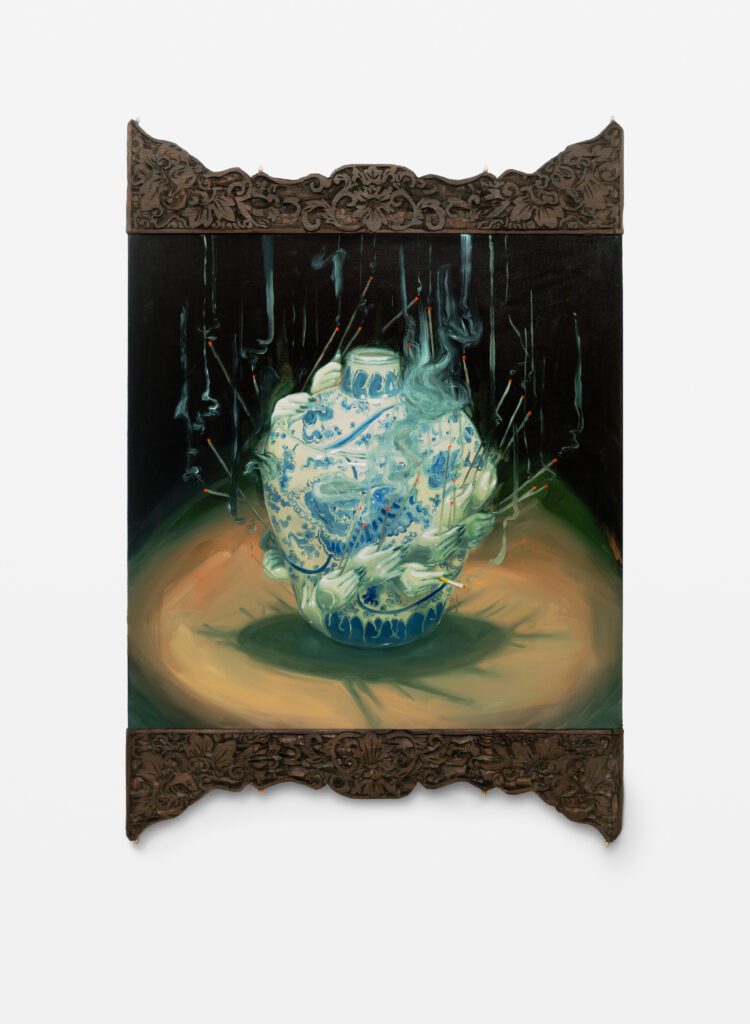
Image Credit: Phuong Nguyen, La Chauve Souris, Mixed Media (oil on panel, hand carved wood frame), 48 x 36", 2025. Photo Credit: Greg McCarthy

Image Credit: Phuong Nguyen: "she died a death by a thousand cuts," Art Gallery of Burlington. 2026. Photo Credit: Darren Rigo

Image Credit: Phuong Nguyen: "she died a death by a thousand cuts," Art Gallery of Burlington. 2026. Photo Credit: Darren Rigo

Image Credit: Phuong Nguyen: "she died a death by a thousand cuts," Art Gallery of Burlington. 2026. Photo Credit: Darren Rigo