
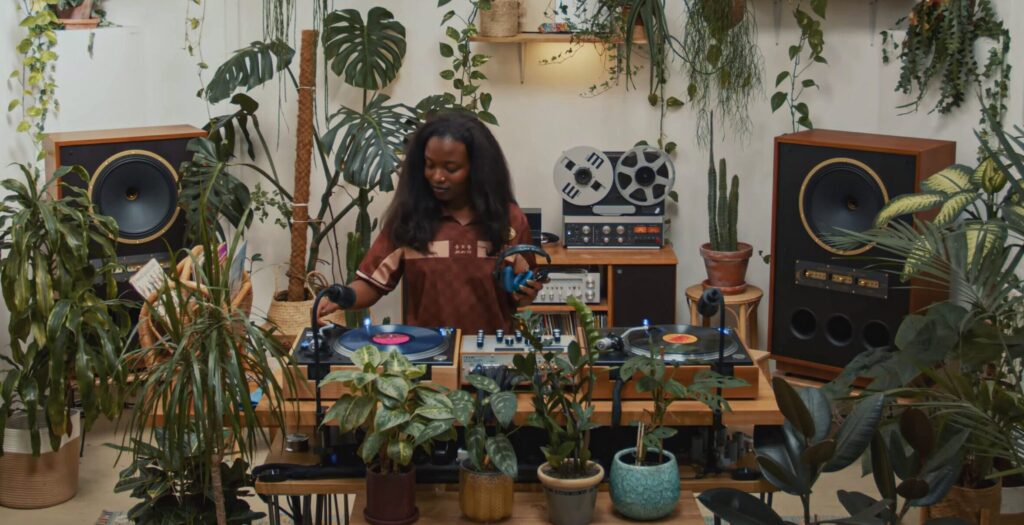
On Saturday June 13th, 12pm–2pm, multidisciplinary artist Olukemi Lijadu presents Recital for the Times 2, a live sonic response to Locutions: Fragments out of a Deluge, an installation solo exhibition of ceramics and sound by Chukwudubem Ukaigwe, at the Art Gallery of Burlington.
Inside a sun-lit greenhouse conservatory within the Gallery, Lijadu performs an audio-visual composition, wielding experimental video projections and melodic sonic contrivances. She weaves an accumulation of field recordings realized through her three-month-long artist residency at Site Toronto with interactions that index local and transcontinental locomotion in sound. These are braided amidst acoustic sediments of quotidian life recorded in Lagos by Chukwudubem Ukaigwe, in confluence with excerpts of music, literature and academic musings on belonging, place and the reproduction of urban life as everchanging.
Throughout the performance, a conversation with Ukaigwe’s exhibition is mediated by Lijadu’s immersive analysis of the music of Emahoy Tsegué Gebru, the late Ethiopian composer, pianist, and nun whose musical compositions and performances elide generic categorization and reflect modern exchanges derived from colonial imposed errantry and displacement. Lijadu explores the ways in which Emahoy’s compositions contest the linearity of time through her use of extreme rubato.
Utilizing computerized and mechanical looping, reversing, sampling and synthesis within a bio-acoustic enclosure, Lijadu breaks up and reassembles fragments of sound and image into a composition of lush and overflow, enacted in real time as durational and improvised.
Header Photo Credit: Zag Erlat
About the Artists
Olukemi Lijadu is a visual and sound artist, who works across sound, the moving image, philosophy and archival images. She is interested in the ways that attempts of sense-making of the world rupture singular or binary understandings of reality – an un-making. Born in London, but raised in her hometown of Lagos, Nigeria she was acutely aware of the cultural hybridity of modernity and how music makes a home for that ability to hold contradiction. Immersed in the extensive CD collection of her father, and armed with a camcorder she received as a gift at 15 she began making what one might conceptualize as legacy work.
Her academic training as a philosopher deeply informs her experimental approach to her practice—she holds a bachelor’s and master’s degree in philosophy from Stanford University, where she focused on African philosophy. She wrote her thesis on Yoruba metaphysics – which compels a world-sense more expansive than the binary modality of what we know to be the ‘west’. Lijadu approaches music as a living archive of communal memory and lost connections critical given the fractured history of the Black diaspora worldwide. With heritage from Nigeria, the Caribbean, and Brazil, the impetus of her artistic practice is both personal and political.
Her work has been presented in institutions and festivals including Spike Island, Bristol (31 January – 10 May 2026), where she presented Feedback, her first institutional solo exhibition and largest to date, The Kitchen (New York City), BlackStar Film Festival (Philadelphia), Frieze Cork Street (London), ICA (London), V.O Curations (London) and Marianne Ibrahim Gallery (Chicago). Under the moniker Kem Kem, she has performed live compositions and DJ sets at major cultural institutions in the UK and internationally, including Tate Britain, Serpentine Galleries, ICA (London), Luma Foundation (Arles), Bozar (Brussels), La Gaîté Lyrique (Paris) and the Nigerian National Museum (Lagos). In 2024 she was a Villa Albertine resident, and in 2025 she was awarded the CIRCA Public Vote Prize and won the VISIO Prize, European Programme on Artists’ Moving Images. She is currently in a three-month long residency at the SITE in Toronto.
—
Chukwudubem Ukaigwe is an artist, curator, and writer. Exercising material as an experimental device for cross-examining plural themes, his interdisciplinary practice is an inquiry into semiotic dissonance. Ukaigwe participates in the creation of immersive audiovisual scapes for fecund contemplation, bringing to center facets of everyday life to generate active conceptual trans-media interconnections pertaining to global aesthetics. Tapping into a diverse spectrum of influences – from experimental music and literature, to history and futurisms – Ukaigwe approaches his art practice as a double gesture. On one hand, his work is a way of annotating, augmenting, defacing, transposing, and rewriting in the margins of a palimpsestic history. On the other hand, his paintings, installations, and video works are an attempt to assemble and compose a speculative sensorium that permits hearing in a different tempo; one that collapses the subject-object divide and maps out both new and revised sociographies. A compositional practice that is fabulated out of the choice to meander in extant modes of being: fugitive, improvised, ongoing and otherwise.
His social practice is established on the foundations of splintered or shared authorship, community input, fracturing time, and relativity. On obtaining a BFA (Hons.) from the university of Manitoba in Canada, Chukwudubem has presented exhibitions and effectuated artist residencies locally and intercontinentally. Ukaigwe is a founding member of the curatorial force, Patterns collective.